FINEST SCALEUP partner Startin.LV provides insights on what makes Latvia such an attractive location for deep tech startups and scaleups.
Spotlight on Latvia’s deep tech surge
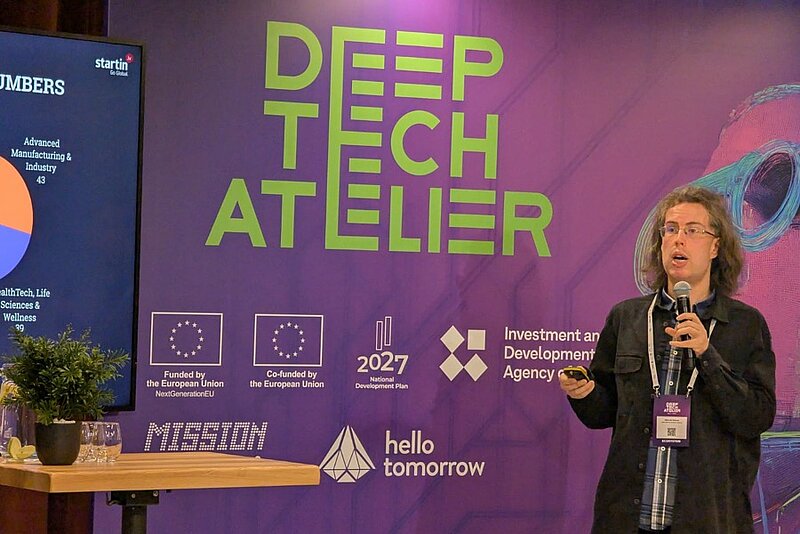
Latvia is experiencing a deep tech surge. During the recent Deep Tech Atelier event in Riga, FINEST SCALEUP project partner Startin.LV took a deep dive into this surge, sharing what makes the country so attractive for deep tech startups and scaleups.
Held 14–15 May, Deep Tech Atelier brought together more than 2,300 participants from 69 countries - further strengthening Latvia’s position as a regional deep tech and innovation hub in the Baltics and Northern Europe.
Latvia’s position is bolstered by the fact the country is among the first in the world to introduce a dedicated startup law. Aimed at attracting both deep tech companies and investments, the law offers two benefit scenarios: a flat social tax and 0% individual income tax or 45% co-financing of talent.
The country also offers a three-year startup visa for all non-EU founders. Not only can one startup have up to five founders with startup visas, the application process takes just one month. It's also spouse and children friendly. Last year, 37 companies took advantage of the visa.
Furthermore, Latvia has a unique fast-track initiative where eligible new investments can see their projects approved in half the usual time.
It’s because of initiatives like these that Latvia now boasts over 560 active startups that employ more than 5,100 people. As of 2025, investments in Latvian startups totalled EUR 78 million, with some of the biggest deals involving such companies as Aerones (EUR 54 million), Trace Space (EUR 4 million) and Handwave (EUR 3.67 million).
2026 is also seeing some big movements in deep tech, with companies like Giraffe 360, Deepspace Energy and Spotwise all securing major investments.
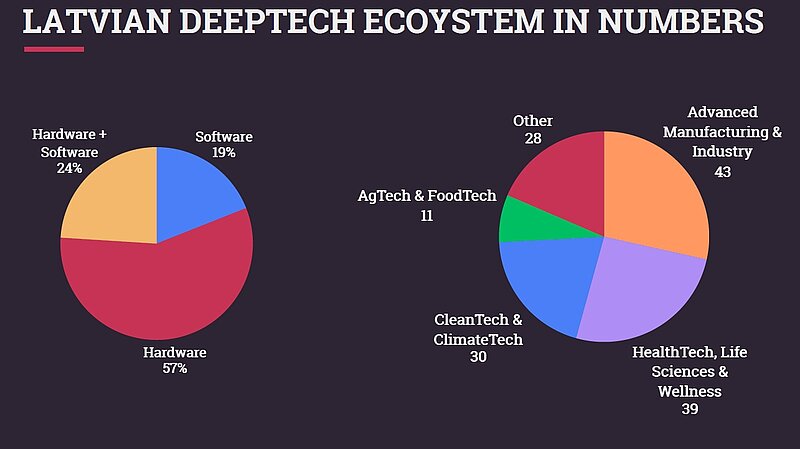
Of the country’s 150 deep tech startups, 43% work in advanced manufacturing and industry; 39% in health tech, life sciences and wellness; and 30% in clean and climate tech. Another 11% operate within the ag and food tech sector.
Other key areas of investment include defence and dual-use tech and AI. Latvia's 24+ defence tech / dual-use startups posted a turnover of EUR 87 million in 2024, while its 62+ AI related startups saw EUR 9.2 million in turnover that same year.
You can read more about the Latvian start-up scene here.
Deep tech by the numbers
Last year, Baltic startups raised EUR 662 million in funds – a significant increase over the EUR 618 million raised in 2024.
Best practices in deep tech commercialisation
Best Practice No. 3: Nurturing deep tech ecosystems through education
Most deep tech startups emerge from universities, which is why educating students is so important. With the right education, students can gain the skills they need to transform ideas and innovations into real products and services.
This is especially true for women.
According to FINEST SCALEUP’s deep tech database, of the 293 companies with available data, only 82 had a female founder.
Behind this low number are several unique challenges that women entrepreneurs face. These include being more risk-averse, having to handle unequal family duties and lacking visible female role models.
While such factors can discourage females from launching a deep tech startup, with targeted education and training, they can gain the skills, confidence and support they need to succeed.
You can learn more about this topic via the FINEST SCALEUP Digital Platform. The platform is free and, once registered, you will have access to a wealth of best practices, exclusive interviews, our deal room database and much, much more.
Closing thoughts
“Latvia is but a snapshot of the dynamic Baltic Sea region, where deep tech is no longer a niche but the core of the startup economy.”
– Eduards Ritums, Startin.LV project manager