The line between deep tech and more traditional technology is often blurred.

What exactly is deep tech?
FINEST SCALEUP talks a lot about deep tech, it is our raison d'être after all.
But what exactly is deep tech?
Turns out, there is no universal definition.
According to the XAnge European Deep Tech Executive Compensation Benchmark 2024 Report, deep tech stands out from other startups and scaleups due to its deep commitment to scientific research, long development periods, and need for significant investment and specialised talent.
In other words, deep tech refers to those technologies that are based on breakthrough scientific discoveries and advanced technological innovations.
That being said, the line between deep tech and more traditional technology is often blurred. For example, technologies utilising artificial intelligence or blockchain are often labelled as being deep tech even though they don’t necessarily rely on groundbreaking scientific achievements but rather on adapting existing solutions.
This lack of a clear definition of what qualifies as deep tech results in an overuse of the term – especially by companies wanting to position themselves as being technologically advanced. On the other hand, startups, often preoccupied with practical applications, may not even realise that they are deep tech.
The bottom line is that, although there is no consensus on what exactly qualifies as deep tech, what really matters is that a particular technology succeeds. And if it offers significant benefits and is backed by advanced scientific research, then it really doesn’t matter whether it calls itself deep tech or not. FINEST SCALEUP calls that a success.
Mark your calendar
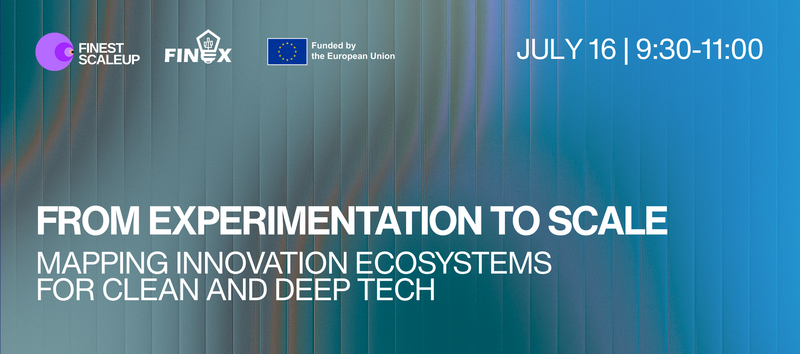
Join us 16 July 9:30 – 11:00 CET for an online event exploring how policymakers and innovation stakeholders can better support innovation through experimentation and scaling.
The event is being co-hosted by FINEST SCALEUP and the FINEX, two Horizon Europe funded projects dedicated to strengthening innovation ecosystems and improving collaboration across such under-connected areas as the Baltic Sea Region, as well as Cyprus and Bulgaria.
Deep tech by the numbers
According to the State of the Baltics Report, deep tech companies in the region raised EUR 328 million in funding last year, up significantly from the EUR 126 million raised in 2020.
Best practices in deep tech commercialisation
Best Practice No. 7: Understanding the investment landscape
Often seen as a risky sector, securing larger funding rounds at later stages of development remains a key challenge for many deep tech startups. For instance, in Finland, deep tech companies face a lack of investors capable of leading large funding rounds, resulting in prolonged fundraising processes.
Although EU grants can help fill in this gap, there are restrictions. Take for example the EIC Accelerator, a popular programme that allows startups to obtain large grants and equity investments for the further development of breakthrough technologies. However, to qualify, a company must have a technology in an advanced stage of development (at least TRL 5/6) and a clear commercialisation pathway.
Another key resource for finding relevant funding is the global database of VC funds created by Hello Tomorrow. Updated regularly, the database includes over 1000 funds that have a stated interest in the European region and deep tech and have completed at least one investment in this sector.
You can learn more about this topic via the FINEST SCALEUP Digital Platform. The platform is free and, once registered, you will have access to a wealth of best practices, exclusive interviews, our deal room database and much, much more.
