28DIGITAL Launches €60,000 Open Call for Incubators to Support Europe’s Next Generation of AI Startups
The European Union has launched LLM-BRIDGE, a Digital Europe Programme–funded initiative…
The transition to a circular economy is one of the European Union's defining strategic priorities and 28DIGITAL is actively contributing to it. Through four EU-funded Horizon Europe projects, 28DIGITAL is working with partners across the continent to tackle some of the most pressing sustainability challenges: from wasteful healthcare supply chains to fragmented materials research, from underserved green tech startups to regional innovation divides. Together, these initiatives reflect a coherent commitment to turn circularity from a policy ambition into an operational reality.
REHEAL (Reverse Healthcare Supply Chains for Circular Economy) addresses one of the least visible but most consequential sustainability challenges in the public sector: the dominance of single-use medical devices in European healthcare. Hospital supply chains today are overwhelmingly linear — products are used once and discarded, generating enormous volumes of clinical waste and significant carbon emissions. Funded with €7.35 million under Horizon Europe, REHEAL brings together health systems in Denmark, Greece, Poland, Spain and Scotland to co-design and pilot digital tools that enable reverse supply chains: solutions for reuse, reprocessing, remanufacturing, repair and material recovery, all while maintaining the highest standards of patient safety. The project uses a Pre-Commercial Procurement methodology to involve industry from the outset, creating a pipeline of circular innovations with real market potential. The REHEAL Followers Community enables suppliers and buyers to get early access to tested solutions, practical peer knowledge, and have a seat at the table where next-generation circular procurement models are being shaped across Europe.
RIVCircular (Regional Innovation Valleys for Circular Economy) takes a different approach: instead of tackling a single industry, it targets the structural fragmentation that prevents circular innovations from scaling across European regions. The project connects eight regions — Madrid, Extremadura, Greece, Hauts-de-France, Vienna, Innlandet, Košice and Kyiv — in a shared programme of interregional collaboration focused on five circular economy priorities: construction and demolition waste, resource and energy recapture, electric vehicle battery recycling, textile industry circularity, and the digitalisation of circular processes. In line with the EU's New European Innovation Agenda, RIVCircular is taking concrete steps to close the innovation divide between EU regions. A nearly €13M open call for collaborative innovation actions is set to launch in the coming months, complemented by structured knowledge exchange initiatives such as a free online course on "Digital Technologies for the Circular Economy" planned for the last quarter of 2026.
FINEST SCALEUP (Elevating the Scalability Potential of Green and Sustainable Deep Tech Solutions) focuses on a different bottleneck in the green transition: the gap between promising sustainability-oriented deep tech innovation and commercially viable, globally competitive companies. Coordinated by the FinEst Centre for Smart Cities and involving partners across the Baltic Sea Region, the FINEST SCALEUP project builds a cross-border investment and support ecosystem spanning Estonia, Latvia, Lithuania, Finland and Poland, with a particular focus on green and sustainable technologies. Critically, it prioritises startups from less-connected innovation ecosystems and women-led ventures — groups that are systematically underserved by existing funding mechanisms. 28DIGITAL's participation contributes its pan-European network and expertise in connecting innovators to funding, policy and market opportunities.
InnoMatSyn (Innovative Materials Ecosystem to Gain Synergies of Regional, National and EU Initiatives) addresses a foundational enabler of the circular economy that often goes unnoticed: advanced and innovative materials. Europe leads the world in materials science, yet its R&D investments are fragmented across national and regional programmes that rarely talk to each other — creating knowledge silos, duplicated efforts and technology leakage risks. Funded with €4 million, InnoMatSyn brings together 14 partners from 10 countries to build a coherent European materials ecosystem. Its core deliverables include an AI-powered knowledge repository connecting existing databases, support for joint funding calls between national agencies, and guidelines to help member states protect strategically sensitive materials innovations.
What links these four projects is a shared way of working. Each one targets a structural barrier — fragmented ecosystems, linear procurement habits, funding gaps, knowledge silos, rather than settling for incremental fixes. Each one uses digital tools as a core enabler. And each one builds the kind of cross-border, multi-stakeholder coalitions that can turn a pilot into a policy model and a prototype into a market.
For organisations looking to engage with the EU's circular economy agenda — whether as technology developers, regional authorities, investors, or research partners — 28DIGITAL's project portfolio offers a concrete and collaborative entry point. With over 50 EU projects ongoing and a growing network of partners across Europe, 28DIGITAL is well placed to help organisations identify relevant opportunities, build consortia, and access EU funding.
Reach out at 28digital.eu/contact-us.
Receive the latest news and events updates by subscribing to our newsletter.
Are you a member of the media and would you like to contact us?
→ Get in touch with us here
 13 March 2026
The European Union has launched LLM-BRIDGE, a Digital Europe Programme–funded initiative…
 5 March 2026
28DIGITAL and EPSI (European Platform for Sport Innovation) have signed a Memorandum of…
 2 March 2026
Europe stands at a decisive moment in deep tech. It has the scientific base, engineering…
 20 February 2026
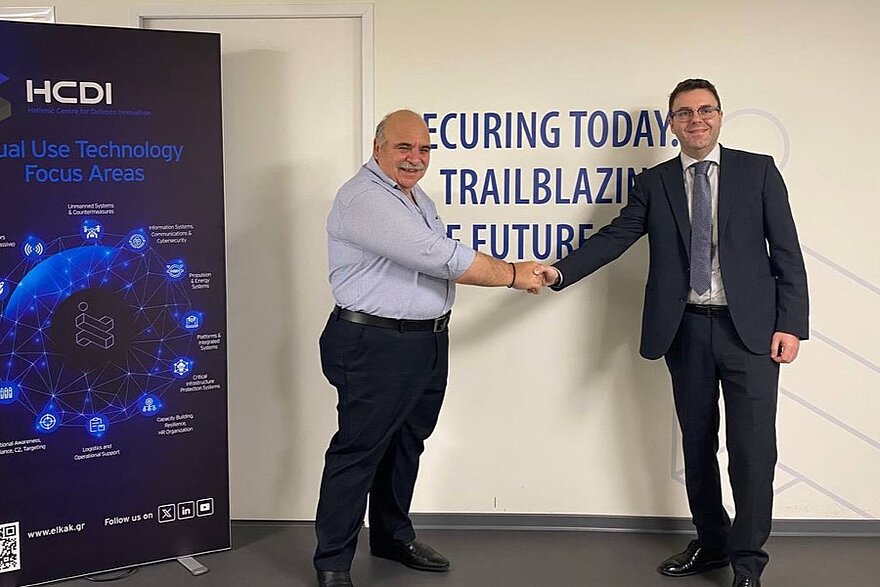
28DIGITAL and the Hellenic Centre for Defence Innovation (HCDI) have established a…
 13 February 2026
Europe stands at a defining moment in its pursuit of competitiveness and technological…
 11 February 2026
28DIGITAL, Europe's leading digital innovation and entrepreneurial education organization,…
Initiated by the EIT
