About DICE
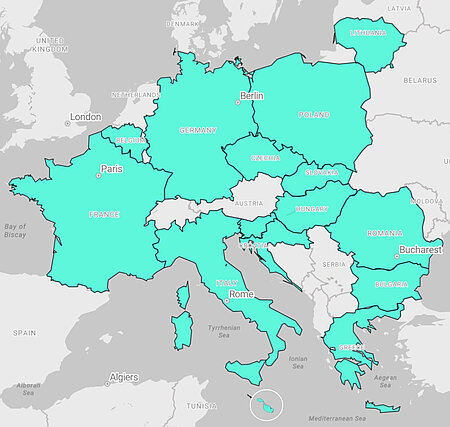
This project aims to enhance the digital capacity of National Competition Authorities (NCAs) across 15 EU Member States by delivering an inclusive, practice-oriented training initiative tailored to varying levels of digital maturity. In response to the growing impact of Artificial Intelligence (AI), data science, and digital technologies on competition enforcement, it focuses on strengthening NCAs’ readiness, skills, and institutional capacity to detect anticompetitive behaviours and enforce competition rules.
By combining modular learning paths with Massive Open Online Courses (MOOCs), hybrid training sessions (in-person and online), workshops, hands-on labs, and a robust Train-the-Trainer model, the project provides a comprehensive, scalable, and sustainable capacity-building framework aligned with the EU regulatory priorities.
Why Digitalisation for the National Competition Authorities
National Competition Authorities are independent bodies responsible for enforcing competition law within their respective Member States. Their core mission is to ensure fair competition, prevent monopolistic practices, and protect consumers by addressing anti-competitive behaviours such as cartels, abuse of dominance, and unfair mergers.
Digital technologies are reshaping market behaviour and dynamics, and NCAs are at the forefront of safeguarding a level-playing field in detecting and addressing anticompetitive practices. While markets become more and more digital, the NCAs are facing growing analytical and investigative challenges in detecting and addressing anticompetitive practices.
The rapid evolution of algorithmic business models and data-driven market power requires NCAs to develop a robust technical, legal, and economic capacity. Strengthened digital capacity is therefore essential to ensure a coherent and effective enforcement of the competition rules across the Single Market.
Our Role
Since it is a single-beneficiary action, 28Digital retains overall responsibility for implementing and coordinating the project in close cooperation with the European Commission. It will ensure that the project is implemented to meet the highest quality standards and within the agreed timeframe by applying a structured and transparent management and monitoring framework.
Our Target Reach and Objectives
The primary target groups are 15 NCAs of participating Member States (Belgium, Bulgaria, Croatia, Czechia, France, Germany, Greece, Hungary, Italy, Lithuania, Malta, Poland, Romania, Slovakia, and Slovenia). These authorities will directly benefit from MOOCs, comprehensive training, and tailored capacity-building activities, strengthening their ability to conduct technologically grounded investigations, apply consistent enforcement methodologies, and thus contribute to a harmonised EU enforcement landscape.
Indirect beneficiaries include businesses operating within EU markets and consumers, who will benefit from transparent, effective and stronger enforcement of competition rules across all Member States.
Project’s Partners and European Collaboration
Several specialised external partners are engaged to ensure the delivery of high-quality outputs, particularly in training design, delivery, and AI domain expertise.
A Knowledge Partner will serve as the primary organisation for curriculum development. With its recognised track record in AI research, digital education, and competition law, the Knowledge Partner is responsible for designing and delivering the training pathways. It provides subject-matter experts to lead the content development and facilitate live learning activities. Importantly, it will also assign qualified tutors to support learners during the asynchronous and synchronous components of the training, ensuring interactive engagement and knowledge transfer.
A Technical Development and Platform Partner (Technical Partner) are engaged to support the design, production, and deployment of the MOOCs.
In addition, independent AI and data science experts are engaged by the coordinator on a case-by-case basis to support specific work packages.
Contribution to EU Policies
The project is strategically aligned with several EU-wide regulatory and digital transformation initiatives. It supports the implementation of the Digital Markets Act (DMA), the Digital Services Act (DSA), and the Artificial Intelligence Act (AIA) by equipping National Competition Authorities (NCAs) with the capabilities required to enforce emerging digital competition rules. Additionally, it contributes to the European Strategy for Data, particularly by enhancing the ability of NCAs to process and analyse large volumes of market and behavioural data. By addressing disparities in digital enforcement capacity, the project also directly supports the EU’s objective of avoiding fragmentation and ensuring consistent application of competition rules across all Member States.
By fostering interoperability, collaborative knowledge practices and shared enforcement standards across Member States, the project ensures alignment with the broader EU competition policy objectives. Furthermore, the project contributes to the goals of the Technical Support Instrument , which include mutual learning, exchange of good practices, and cross-country knowledge sharing (TSI-2025-DICE-IBA). This ensures policy coherence and maximises the impact of digital transition investments at both national and EU levels.

DICE is funded by the European Union via the Technical Support Instrument and implemented by 28DIGITAL, in cooperation with the European Commission. Views and opinions expressed are, however, those of the author(s) only and do not necessarily reflect those of the European Union. Neither the European Union nor the granting authority can be held responsible for them.
